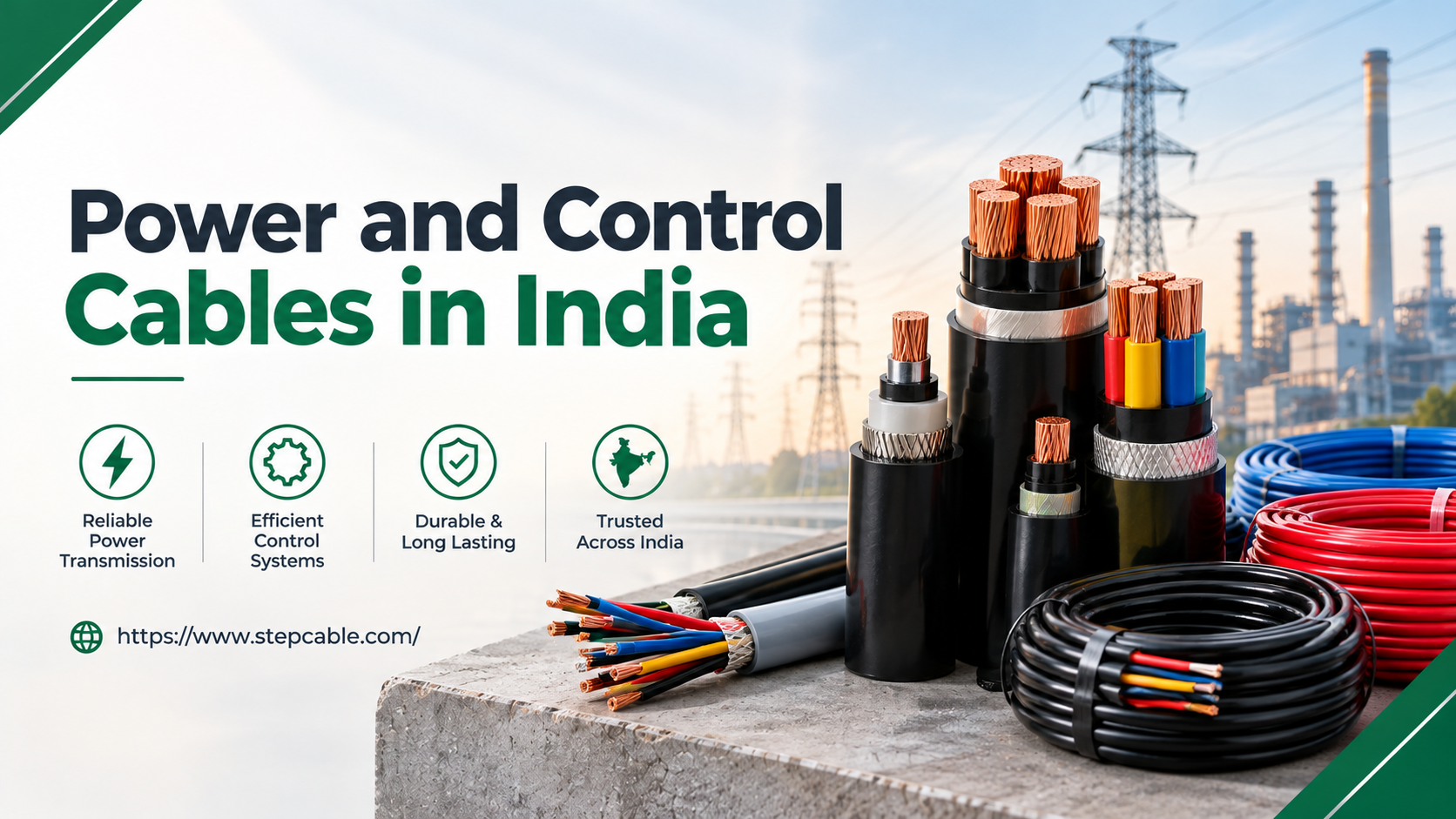
Industries need power to run smoothly. Whether light, industrial, or heavy, work is performed at a plant, construction site, power station, or in fully automated production, the industry depends on electrical systems to operate stably, safely, and without unnecessary interruptions.
Power and control cables in India deliver energy; meanwhile, control cables aim to deliver signals for the control of equipment, synchronisation, and automation of processes. While it may seem counterintuitive to have two separate types of cable, in practice they work synergistically to build a robust electrical system.
Presently, any organisation searching for power and control cables in India requires them to meet its voltage and operational requirements, as well as to be applicable to the specific operations of the organisation. The right cables may increase reliability, ease of use, and long-term operation.
Understanding the Role of Power and Control Cables in Industry
Electrical Power and Control Cables in India are an integral part of your industrial electrical system. They are manufactured for various uses, and their construction, conductor size, insulation and protection differ.
Understanding Power Cables
A power cable is a type of cable, part of the cable bundle, used for the distribution of electrical power. Power cables are used in industrial facilities, commercial construction, infrastructure projects, power distribution, and more.
Specialised for particular voltage and current levels, these cables also include conductors that can be aluminium or copper, as well as tough insulation and an outer protective layer.
Typical uses include:
- Supplying electricity to industrial machinery and motors.
- Connecting electrical distribution panels and transformers.
- Reliably supporting power distribution of factory and commercial premises.
- Offering electrical connections for energy and infrastructure jobs.
- Connecting pumps, compressors, and other industrial equipment.
The selection of the right power and control cables in India depends on a detailed assessment of the cable’s current-carrying capability, voltage rating, installation conditions and electrical standards.
Understanding Control Cables
Control cables function as the link between control panels, industrial instruments and industrial machinery. Control cables allow the operator to operate and monitor various components of a manufacturing process or machine.
The control cables, in contrast to power cables (which are mainly used to transport electrical energy), are usually used as command signals, as well as for monitoring and control of the equipment.
Their common applications include:
- Connecting control panels with industrial machinery.
- Supporting automated manufacturing processes.
- Transmitting signals between sensors and control systems.
- Managing equipment operations in production facilities.
- Connecting monitoring devices and industrial instruments.
A control cable can be constructed with several cores, as well as shielding and insulation to prevent electrical interference and withstand environmental conditions.
Advantages of Power and Control Cables in Modern Industries
Industrial productivity requires secure wiring. Correctly selected cables enable businesses to run things safely and efficiently, helping to ensure the smooth operation of various pieces of equipment.
Reliable Power Transmission
They need a steady power source to function properly. Power and Control Cables in India effectively carry electricity when the appropriate size and are installed to minimise unnecessary energy losses due to excessive voltage drop.
For factories that run machinery that uses a lot of power, loading your cables properly should be a priority. Cable sizing can help you avoid these issues and even avoid a potential fire.
Enhanced Industrial Automation
Automation has taken a central role in manufacturing. Manufacturing lines, for example, rely heavily on sensors, programmable logic controllers, control panels, and other electronic devices.
Power and control cables are used to carry the signals needed to communicate and synchronise the operations of the equipment. The signal transmission must be reliable so that the machinery will react properly to your commands and produce reliably.
Safer Operation
Electrical safety in the workplace will primarily consist of the excess or excessive wear and tear on an average workplace cable that might lead to issues such as excessive surface temperature, short circuits, and damage to cables and/or equipment.
Where the correct wire is used and it is installed and protected correctly, many of these hazards can be minimised. Using cables that are insulated with the correct voltage, protection, conductor sizes, etc., and to the correct specifications will further decrease these risks.
Reduced Maintenance Requirements
Downtime in the factory can have a bearing on production times and costs. Using quality cables that are specifically chosen for their proposed use environment will help to prevent all potential premature deterioration and electrical failure.
Better Equipment Coordination
Today’s industrial sites frequently run several pieces of machinery at once. The control system enables control of the operation of these devices and can control conditions, sequences of operation and more.
Power and control cables in India enable communication between separate electrical parts. When used with properly designed control systems it can help businesses keep production moving more smoothly and operations more predictable.
Backing the Growth of Industry
Upgrades: As companies grow and add more equipment to their facilities, they may also have to upgrade their electrical system. Planning for future growth and choosing the right cable types can simplify expansion.
Partnering with a power and control cables in india supplier that has qualified products and suppliers helps project teams to find the right product for their technical needs, installation conditions and more.
Key Differences Between Power Cables and Control Cables
Although both cable types are important, their functions and design requirements differ.
| Comparison Factor | Power Cables | Control Cables |
| Primary function | Transmit electrical energy | Carry control signals |
| Typical applications | Motors, distribution panels, machinery | Control panels, sensors, automation systems |
| Design priority | Current capacity and voltage rating | Signal integrity and control requirements |
| Conductor sizing | Based on electrical load and installation conditions | Based on signal, current, and circuit requirements |
| Construction | Insulation and protection suited to power transmission | Multiple cores and optional shielding for signal applications |
| Selection factors | Load, voltage, temperature, installation method | Signal type, interference, flexibility, and environment |
The final choice depends on the equipment design and electrical specifications. Some industrial installations require both cable types to operate together as part of an integrated electrical system.
Why Choose Us?
Choosing a good supplier or cable manufacturer in a plan is an important step in designing a reliable electrical system. The technological capabilities, product range, product quality and compliance of suppliers with project requirements should be taken into consideration.
Step Cables intends to meet the electrical and industrial needs with cable proposals that are appropriate for the various applications. Here’s what all companies should ask themselves when looking for a supplier:
Product Suitability
Every application has different electrical and environmental needs. Ensure the voltage rating, conductor material and insulation, and use conditions for the cable are suitable for the application.
Quality and Compliance
Cables must be manufactured consistently to provide dependable performance. The customer needs to see the respective test report of the product and technical documentation and their compliance to the applicable Indian and international standards where applicable.
Technical Guidance
Large industrial projects are frequently faced with finding products on complicated specifications. Getting simple technical information and help making the buying decision can often be a challenge.
Application-Based Solutions
Different cable constructions might be necessary for indoor use, outdoor operation, machine connections or control systems. Using products to match the actual operating conditions can help ensure reliable operation.
Process for Selecting the Right Industrial Cables
Power and Control Cables in India selection is not only driven by a cost analysis. Such an organised process helps to verify the technical properties are being matched and that they will be compatible within the application.
Specify the Application
Ascertain that the cable is being required for distribution of power, machinery wiring, automation, instrumentation, or control panel wiring. This sets a standard cable type.
Determine the Electrical Need
Look at the operating voltage, the current load, the demand, and any starting currents of connected loads. Take into consideration the installation conditions and allowable voltage drop when sizing the cable.
Evaluate the Installation Environment
Ask yourself if the power and control cables will go inside, outside, underground, in trays, or adjust to heat, dampness, chemicals or damage.
Verify Standards and Certifications
Examine applicable electrical codes, applicable IS or IEC standards, product certification and test certificates. Demands will be different based on cable kind, voltage class and also the application.
Compare Product Specifications
Contrast the ability to compare conductor material, core configuration, insulation, sheath, shielding, flexibility and other specifications. Make sure your choice is in accordance with recommendations of manufacturers of the equipment.
Plan Installation and Maintenance
Use the services of qualified personnel to install the cables with appropriate fixtures and recommended procedures. Inspect and test the system periodically to detect degradation, loose connections, and other issues early on.
Conclusion
Power and control cables are a part of the development of industry. Power cables deliver power to load equipment, while control cables carry signals and commands to automation systems and controls for machinery and instruments and between individual pieces of equipment. We help make industry safer and more productive.
We are ideal for commercial applications and power lines. If you want to buy Power and Control Cables in India, test for your Technical acceptance, verify the Manufacturing quality, standard and conditions of the Cables at your site. We will deliver best performance when you choose the right choice with professional installation.
Step Cables should be viewed as a starting point for businesses searching for cable solutions for both industrial and electrical projects. By scrutinising specifications and comparing to project needs you organisations can provide electrical infrastructure capable of facilitating modern industrial standards.
FAQ
What is the major difference between power cables as well as control cables?
Power and Control Cable deliver the electrical power to the equipment, while control cables are used to convey signals to control, monitor and coordinate industrial machinery and equipment.
Where are power cables commonly used?
Power Cables are employed by factories, commercial centres, power transmission grids, infrastructure projects, and manufacturing plants for powering motors, panels, pumps, and more.
Why are control cables important in industrial automation?
They assist with transmitting commands and signals needed for automated operations, monitor machinery, and integrate production.
What factors affect cable performance and service life?
The performance of cable is determined by the inherent quality of the product, correct sizing, operating temperature, electrical load, installation method, any environmental exposure and the maintenance performed on the product.
Can power and control cables be used in the same industrial facility?
Yes. Both are used in many industrial plants. The power cables provide electric power to a device, while the control cables transmit signals and commands for the device’s operation. The installation of both types must comply with the rules for safety and interference control.